
Invoice capture that understands the accounting.
LinesFlow reads invoices, checks their accounting meaning and prepares them for Sage, Xero and QuickBooks — while blocking anything it cannot support safely.
- Understands complex tax
- Reconciles before posting
- Never guesses when the evidence isn't enough
30 days free. No credit card required.
One UK construction invoice
LinesFlow found:
- Understood: Standard VAT£775.83
- Understood: Reduced VAT£150.00
- Understood: Zero-rated works£5,000.00
- Understood: VAT-exempt insurance£120.00
Read as a memo: Domestic reverse charge
- VAT shown on the invoice
- £800.00
- VAT charged by the supplier
- £0.00
- Understood: Retention held£799.96
- Understood: CIS deduction£360.00
- Understood: Already paid£2,000.00
- VAT on the invoice
- £925.83
- Invoice reconciles as printed
- £16,924.96
- Payable now
- £13,765.00
A worked example
Ten figures on one invoice. Several don't mean what they look like.
Every figure on the invoice above was read correctly. The work is deciding what each one means: which VAT is reclaimable, which deduction is money already gone, which is owed to a tax authority, and which is still owed to the supplier.
Most invoice tools extract these numbers. LinesFlow determines what they mean.
It found £800.00 of VAT — and correctly didn't add it to the invoice.
The invoice prints £800.00 of domestic reverse-charge VAT for information. The supplier charged none of it. LinesFlow reads it as a memo, keeps the invoice's VAT at £925.83, and still reconciles the document to £16,924.96.
Summed as VAT the supplier charged, it would read £1,725.83 — a figure the document states nowhere.
A £360.00 CIS deduction beside a £2,000.00 payment is not £2,360.00 already paid.
All three deductions subtract from what the supplier gets paid, so the arithmetic cannot tell them apart. Their accounting consequences are entirely different: retention is owed to the supplier later, CIS is owed to a tax authority, and a payment on account is money that has already moved.
LinesFlow shows the three separately, and refuses a payable it cannot reconcile against the document.
Safe refusal
When LinesFlow isn't sure, it doesn't guess.
Some invoices cannot be posted safely from the evidence on the document. LinesFlow identifies the ambiguity, explains what needs reviewing, and blocks the posting until it is resolved.
Invoice reconciles as printed
£16,924.96
Lines, tax, deductions and the payable all agree with the document. Nothing needed a reviewer's judgement, so nothing asked for one.
Posting blocked — domestic reverse charge
£4,000.00net, held for review
This organisation's tax catalogue publishes no code that represents a reverse charge. LinesFlow will not substitute a standard-rated one, and will not choose between two candidates it cannot tell apart — a domestic reverse charge and an EC acquisition are different boxes on a VAT return.
An unprovable code on a real VAT return is worse than a refusal.
How it reaches your ledger
One accounting interpretation. Platform-specific posting.
The accounting is decided once, from the document. How it is represented is decided per platform, against that organisation's live tax catalogue — not from a rate guessed off the invoice. Sage, Xero and QuickBooks do not represent the same accounting event the same way.
What the supplier printed is preserved throughout, separately from what LinesFlow concluded, so a reviewer can always see both.
What it does
Understand, check, resolve, post.
Extraction is the first step, not the product. Everything after it is about whether the proposed posting reflects what the document actually says.
Understand
Lines, tax treatments, discounts, credits, deductions and payments on account are read as what they are — not as amounts on a page.
Check
Totals, tax, the payable and the document's own arithmetic are reconciled against what the supplier printed.
Resolve
Where the document leaves something genuinely ambiguous, LinesFlow names it and asks — only where it has to.
Post
The proven treatment is translated into the connected platform's own tax code, resolved against that organisation's live catalogue.
The review workspace
The document beside what LinesFlow made of it
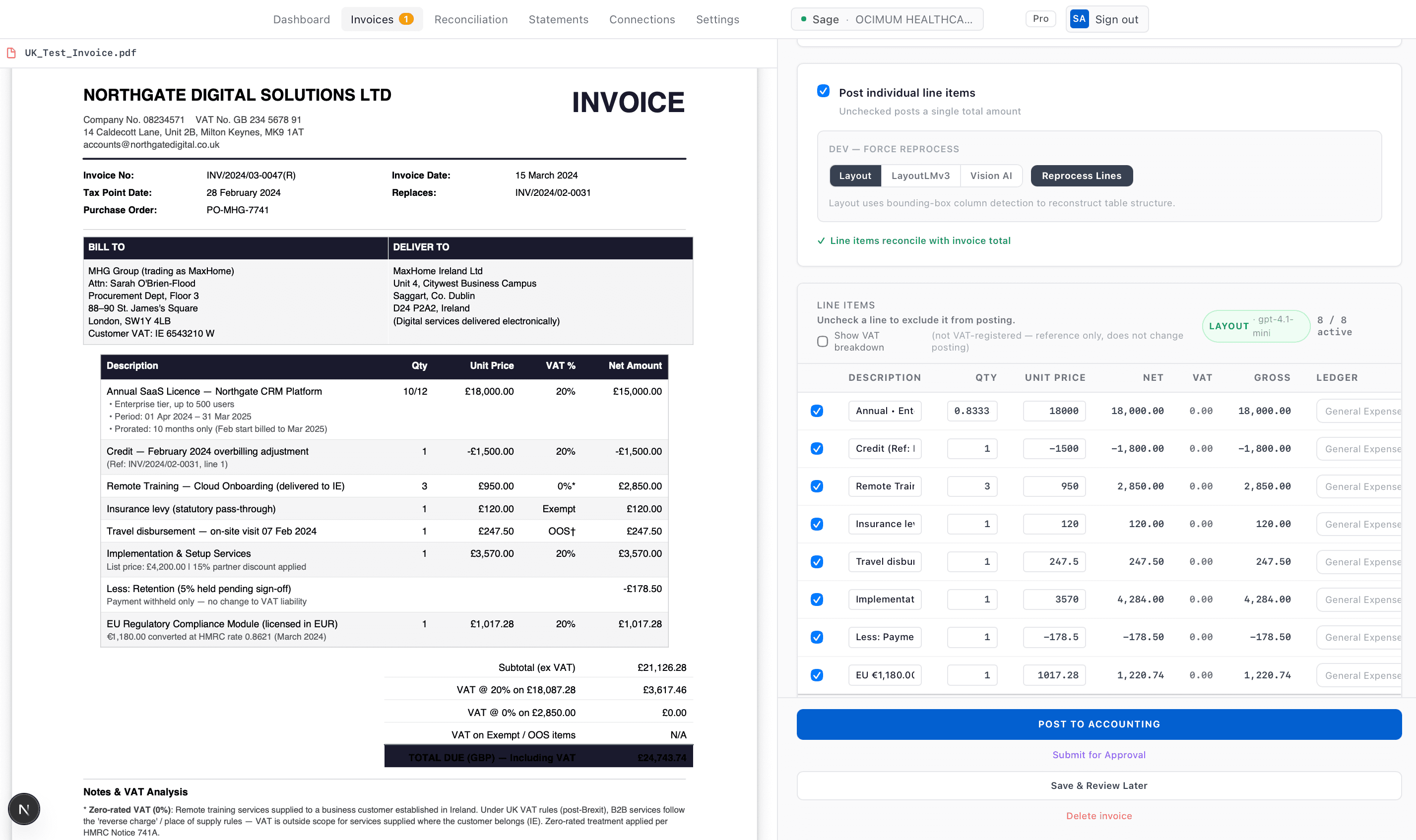
Built for the invoices that aren't straightforward.
- mixed VAT rates
- reverse charge
- CIS
- retention
- import VAT
- payments on account
- credit notes
- discounts
- withholding
- Insurance Premium Tax
- mixed sales tax
Each of these is read, reconciled and shown separately. Where the destination platform can represent it, LinesFlow posts it; where it cannot, LinesFlow says so instead of approximating.
Where it posts
Posts to the accounting platforms you already use.
Security & data handling
Your invoices, your books, your call.
Accounting connections are encrypted, documents are retained only as long as they are useful, and nothing is posted without your approval.
Encrypted accounting connections
OAuth access and refresh tokens are encrypted at rest, with safe rotation when they expire.
PDFs kept 7 days
Posted documents are retained for 7 days, then removed. Unposted drafts expire after 7 days.
Delete and export, your call
Export everything you hold in one ZIP, or erase your account and all related data at any time.
Nothing posts silently
Every posting is an explicit, auditable act — never a background side effect of an upload.
Product demo
See the review workflow before you connect accounting.
Follow a test invoice from upload through line validation, supplier and ledger matching, explicit approval, and a successful Sage posting.
Playing the demo loads it from YouTube, which may set cookies. Nothing is requested from YouTube until you press play.
Other tools extract what's written on an invoice. LinesFlow checks what it means before it gets posted.
Post your first invoice today — free.
Upload an invoice, review what was extracted, and post it to your accounting platform. 30 days free, no credit card required.
Built for businesses, sole traders, accountants, and bookkeepers doing business accounting.